
Method Standardization: Unified full testing workflow.
High Data Repeatability: Stable, globally comparable test results.
Ultra-High Precision: Detects sub-50μm fine particles.
Full Audit Compliance: Complies with PPAP, IATF16949 & OEM audits.
Dual Extraction Compatibility: Supports wet and dry extraction.
Dual Analysis Mode: Particle counting & contamination tracing.
Wide Industry Authority: Global automotive cleanliness benchmark.
Continuous Iteration: Updated for precision manufacturing.
1. Core Definition
VDA 19.1 is the authoritative German automotive industry standard for technical cleanliness inspection of functionally relevant automotive components. It defines standardized, repeatable laboratory testing methods for free solid particulate contamination on component surfaces. As the core compliance benchmark for German automotive supply chains, it unifies particle extraction, filtration, analysis and reporting procedures to ensure consistent, comparable and traceable cleanliness test results worldwide.
Official Full Name: Inspection of Technical Cleanliness – Particulate contamination of functionally-relevant automotive components
Valid Versions: 2015 2nd Edition (widely adopted) | 2025 3rd Revised Edition (latest version, officially implemented in 2026)
2. Application Scope & Industry Scenarios
2.1 Applicable Components
Covers functional precision parts for both traditional fuel vehicles and new energy vehicles:
Powertrain System: Engine parts, transmission components, hydraulic valve bodies, oil pumps, bearings
Chassis & Safety System: Brake and steering precision components
Fluid Circuit System: Cooling, air conditioning, intake and exhaust parts
NEV Core Components: Drive motors, reducers, inverters, battery cooling plates, fuel cell parts
Automotive Electronic Parts: Cameras, radar shells, electronic control housings
2.2 Applicable Contaminants
Only applicable to removable free solid particles: metal chips, sand grains, plastic powder, fiber debris, welding slag and other solid impurities.
2.3 Business Application Scenarios
New product sample approval, IQC incoming inspection, OQC delivery inspection, cleaning process validation, failure root cause analysis, OEM compliance audit, and PPAP document submission.
2.4 Non-Applicable Range
Excludes oil film, grease, VOC, ionic contamination, hydraulic oil cleanliness (ISO 4406), on-site environmental management (VDA 19.2), and firmly embedded non-extractable particles.
3. Standard Complete Testing Process
All tests require mandatory pre-test verification to guarantee valid and audit-proof data.
3.1 Mandatory Pre-Test Verification
Blank Test: Eliminates background contamination from solvents, utensils and laboratory environments to ensure accurate baseline data.
Declining Test: Confirms sufficient particle extraction, verifying that adopted test parameters can fully remove free surface particles.
3.2 Formal Testing Steps
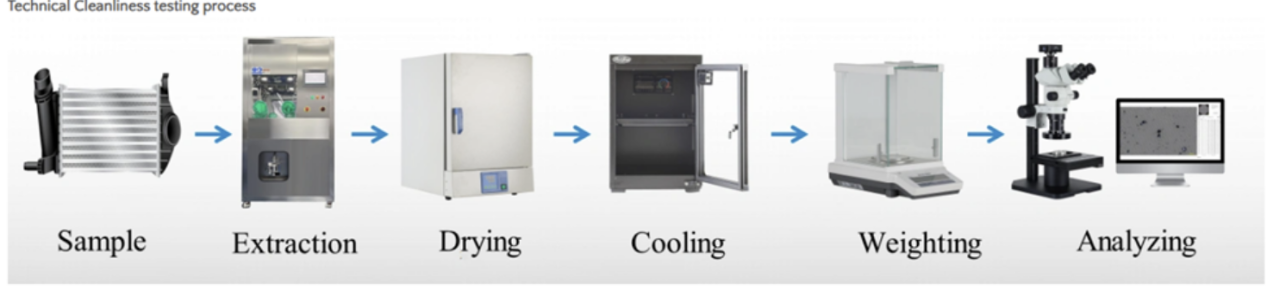
1.Sample Preparation: Disassemble and protect samples in a controlled clean environment, record component information and test specifications.
2.Particle Extraction: Supports dual extraction solutions. Traditional wet extraction includes ultrasonic cleaning, pressure spraying and immersion flushing. New dry extraction (2025 update) includes vacuum suction and stamp sampling for liquid-sensitive electronic components.
3.Filtration & Drying: Capture contaminants via standard filter membranes, dry membranes to constant weight, and control qualified particle coverage rate.
4.Multi-Dimensional Analysis: Conduct gravimetric testing for total residue weight, optical microscopy for particle size grading and quantity statistics, and SEM/EDX analysis for particle morphology and material identification.
5.Result Evaluation & Reporting: Deduct blank values, compare test data with customer-specific limits, and issue official VDA 19.1 test reports with standardized CCC (Component Cleanliness Code).
4. 2025 Latest Version Core Upgrades
Officially incorporates SEM/EDX material analysis as a standard testing method, enabling precise particle source traceability and failure analysis.
Optimizes detection criteria for micro-particles below 50μm, greatly improving accuracy for ultra-fine contamination inspection.
Adds two new dry extraction technologies, covering non-washable precision components that cannot adopt liquid cleaning.
Updates unified extraction parameter benchmarks, and optimizes measurement uncertainty calibration and out-of-spec response specifications.
5. Core Advantages & Standard Comparison
5.1 VDA 19.1 VS ISO 16232
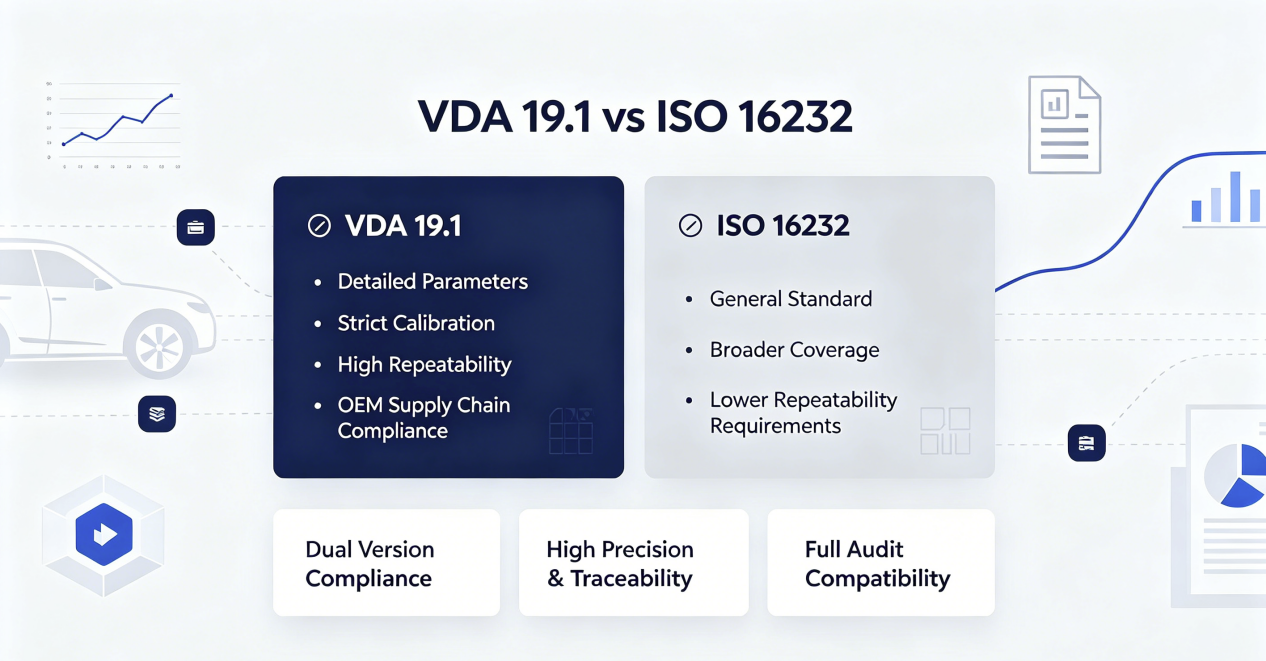
ISO 16232: A universal international standard with broad coverage but relatively general operation specifications and low data repeatability requirements.
VDA 19.1: A professional German-system standard with detailed operational parameters, strict data calibration rules and superior test repeatability. It is mandatory for all German OEM supply chains and high-end new energy vehicle projects.
5.2 Our Solution Advantages
Dual Version Compliance: Supports both classic 2015 version and latest 2025 updated version to meet different OEM audit requirements.
High Precision & Traceability: Multi-dimensional particle analysis realizes accurate quantification and complete contamination source tracing.
Full Audit Compatibility: Strictly follows standard pre-test verification and reporting rules, fully compatible with PPAP, OEM incoming audit and batch quality inspection requirements.
6. FAQ
Q1: What is the difference between VDA 19.1 and VDA 19.2?
A1: VDA 19.1 focuses on laboratory component particle detection and data analysis for finished parts. VDA 19.2 governs on-site process cleanliness, including workshop environment, tooling, personnel and logistics contamination control. The two standards are complementary and commonly used together in automotive quality management.
Q2: Does VDA 19.1 specify unified particle limit values?
A2: No. VDA 19.1 only defines standardized testing methods and procedures. The specific cleanliness limit values (particle size, quantity, weight) are formulated separately by OEMs and specified in customer drawings or technical specifications.
Q3: Which extraction method should be chosen, wet or dry?
A3: Wet extraction is the mainstream solution for common metal and plastic parts. The new dry extraction method is specially designed for liquid-sensitive precision electronic components. The final solution needs to be confirmed per customer requirements and component characteristics.
Q4: Why are blank test and declining test mandatory?
A4: The two pre-tests are core audit items of VDA 19.1. They eliminate external background interference and verify the effectiveness of extraction parameters, ensuring all test data is authentic, repeatable and internationally recognized.
Q5: Is VDA 19.1 applicable for non-automotive industrial parts?
A5: Though originally designed for automotive components, VDA 19.1 is widely adopted as a high-precision cleanliness inspection benchmark for hydraulic valves, precision machinery and industrial fluid system components across various industries.
Q6: What are the application scenarios of SEM/EDX analysis in the new version?
A6: SEM/EDX analysis identifies particle material composition and morphology, helping trace contamination sources such as metal cutting debris, sand dust and rubber wear debris. It is widely used in product failure analysis and process quality optimization.
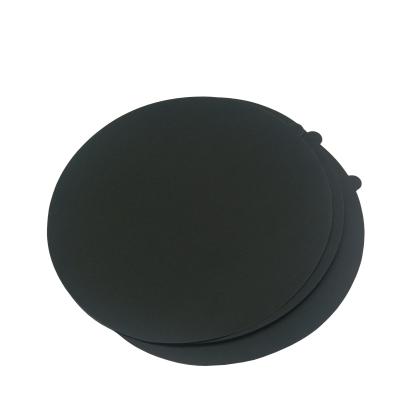
Abrasive Paper is made of imported latex paper base and strictly graded silicon carbide abrasive processed by electrostatic sand planting process. The product has the characteristics of good water resistance, strong grinding and excellent wear resistance. Pressure sensitive adhesive sandpaper with advanced transparent double-sided tape, no residue, more convenient to use.
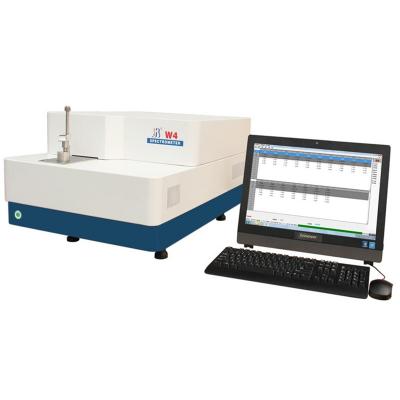
High resolution CMOS readout system
Low total cost of ownership
Vacuum optics enabling fast stabilization
Excellent long-term stability
Intelligent design, Modular design
Ferrous and non-ferrous applications
Easy to use with full PC control
Friendly user interface
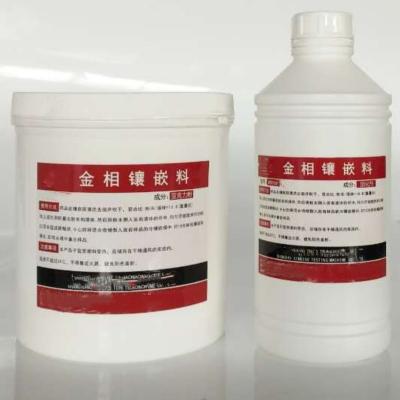
The product is refined from imported raw materials. During the production process of printed circuit boards, in order to monitor the thickness of the coating in the PTH hole, the line etching side etching rate, etc., metallographic section microanalysis must be performed. It is a special chemical product for metallographic slice molding using acrylic resin as the main raw material. It has excellent properties such as smooth and fast curing at room temperature, few bubbles, no discoloration after long-term storage, high hardness, and acid and alkali resistance.
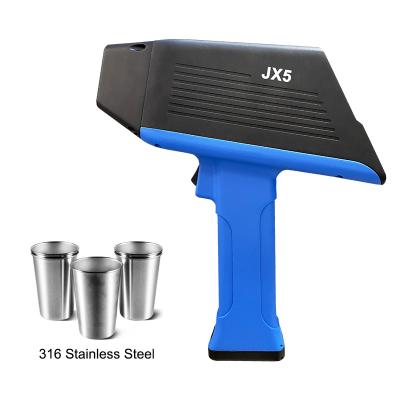
High-Performance Analyzers for 316 Stainless Steel
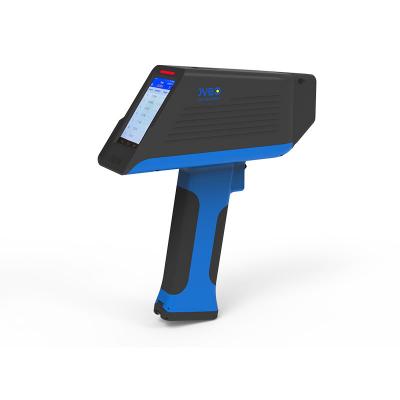
The fastest handheld XRF analyzer.
Ultimate on-site metal detection capability.
Grade identification in 1 second for any metal.
Full chemistry testing in 3-5 seconds for stainless steel and other alloys.
Full chemistry testing in 7-8 seconds for aluminium alloy.
Everywhere data & documentation.
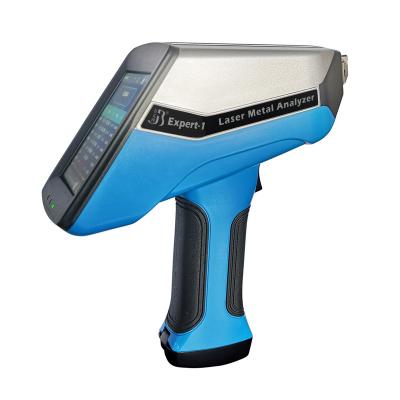
Expert 1 Handheld LIBS Analyzer
Fast. Durable. Accurate.
Reliable, high-productivity metal grade analysis in only 1 second for most alloys
Idea for scrap metals sorting
Positive Material Identification (PMI)
Safe and nonradiative
Low owner cost
Especially for aluminium alloy grade and composition analysis
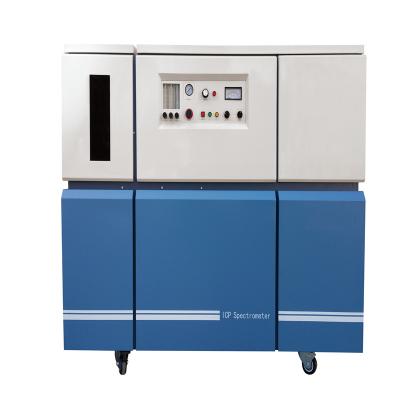
Simultaneous ICP-OES for elemental analysis of liquids
Wavelength range:195-800nm
For 70 trace elements and macroelements
Analyze up to 600 samples per day
Low operating costs
Intuitive operation
Ultra-low limits of detection
Ultra-high speed of measurement
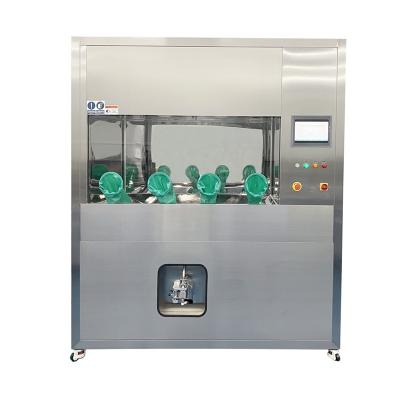
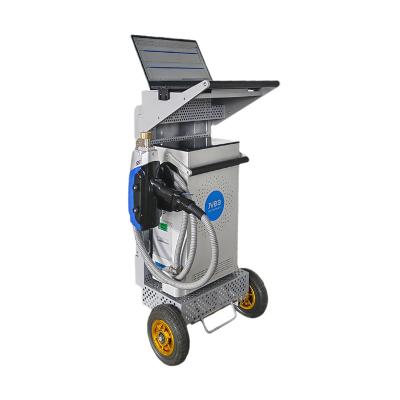
According to VDA19.1, ISO16232 and internal standard.
Technical and ergonomic optimizations and significant safety.
Automatic cleanliness extraction system.
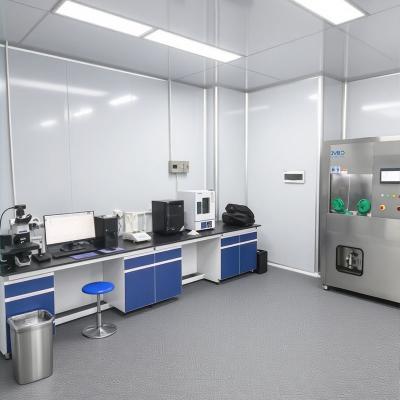
Class 100 operation chamber.
Extraction options include pressure rinsing,ultrasounic, shaking rinsing, internal rinsing, air blow.
Customization available.
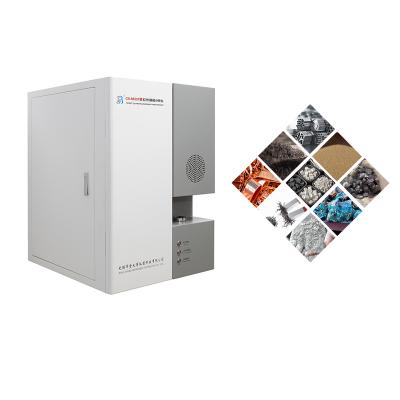
Excellent long-term stability
Low operating cost,easy maintenance
High integration,reliability,stability
Flexible,reliable and safe on-site analysis
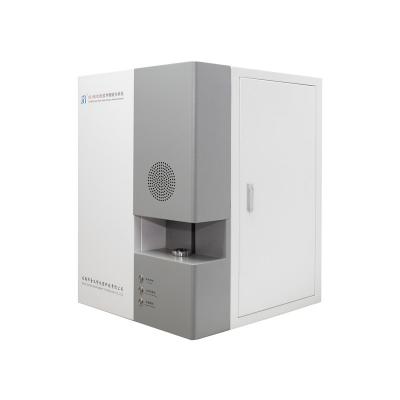
Carbon monoxide conversion
Automatic detection of solenoid valve
Full scale linear calibration
Key Applications:Mainly used in graphite,coal, coke,carburant,rubber,pyrite,coal gangue.

© Copyright © 2026 Wuxi Jinyibo Instrument Technology Co.,Ltd All Rights Reserved.
Sitemap | Xml | Privacy Policy | 苏ICP备18046951号-1