W4 Arc-Spark OES – Cost-Effective OES for Scrap Metal Sorting & Alloy Grade Identification
Meta Description: W4 optical emission spectrometer delivers fast, precise alloy grade verification for scrap yards, foundries & metal recyclers. Key specs, use-cases and comparison against handheld XRF.
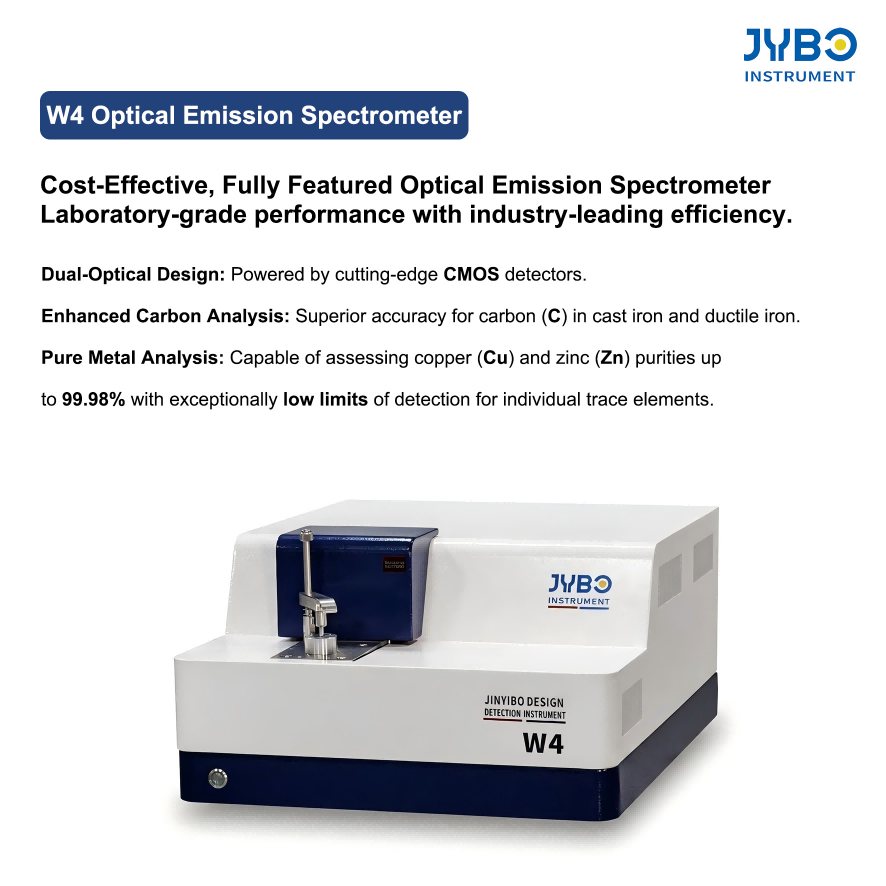
W4 Arc-Spark Optical Emission Spectrometer: Economical OES Solution for Scrap Metal Sorting and Alloy Grade Identification
Introduction
Scrap metal recycling, foundry smelting and incoming-material quality inspection industries demand stable, cost-effective bench-top Arc/Spark-OES instruments for rapid multi-matrix metal composition analysis and alloy grade determination.
Developed by Wuxi Jinyibo Instrument Technology, the W4 full-spectrum arc-spark optical emission spectrometer is an economical metal analyzer built for furnace-side rapid analysis, scrap metal sorting, alloy grade recognition and laboratory material quality control.
Equipped with high-resolution multi-CMOS detectors covering 165-589 nm wavelength range, the W4 supports most common metal matrices including Fe, Cu, Al, Ni, Mg, Ti, Zn, Pb, Sn and Ag. It delivers reliable quantitative results for both trace low-level elements and high-concentration major alloy components. It fills critical performance gaps of handheld XRF instruments which cannot accurately measure light elements such as Carbon, Nitrogen and Boron. The W4 provides quantitative analytical data for scrap grading, mixed-material screening and incoming-goods re-inspection.
Weighing approx. 40 kg with compact footprint, the unit fits both furnace-side stations in foundries and inspection laboratories for metal recyclers. It has been deployed for steel, casting and metal-recycling customers across the globe.
Why OES is Essential for Scrap Sorting & Alloy Grade Verification
Industry Pain Points
In scrap-metal trading and metal recycling, material value is fully determined by chemical composition. Visual inspection or simple spark grinding cannot distinguish subtle alloy differences. While handheld XRF offers fast field screening, it has inherent limitations for light-element analysis. Mis-identification can lead to direct financial losses and production failures.
1. High risk of mixed alloys: Visually identical scrap pieces of different grades are frequently mixed. Mis-classifying high-value alloys as low-grade scrap, or feeding low-grade scrap into premium melting batches causes financial loss and casting rejects.
2. Blind-spot for light-element measurement: XRF cannot reliably detect C, N, B — key differentiators for many stainless steels, tool steels and aluminium-magnesium alloys.
3. Rising compliance & arbitration requirements: Increasing numbers of overseas recyclers and foundries require traceable full-composition test reports. Qualitative XRF screening alone fails trade acceptance and quality-archiving standards.
4. High entry cost for imported OES: Conventional imported bench-top OES systems carry high capital and maintenance costs, putting them out-of-reach for small-to-medium recyclers and foundries.
How W4 OES Resolves These Challenges
Arc-Spark OES is the globally-recognised reference technique for alloy grade confirmation and scrap-metal arbitration testing. By exciting metal samples via arc-spark discharge and capturing full-spectrum signals for simultaneous multi-element quantification, OES delivers definitive compositional results. The W4 preserves core analytical capability at a much lower total-cost-of-ownership for SME-level budgets.
1. Digital arc-spark excitation source with 100-1000 Hz spark frequency and HEPS High-Energy Pre-Combustion technology optimises discharge parameters for ferrous and non-ferrous scrap, stabilising results from inhomogeneous waste samples.
2. CMOS full-spectrum detection covering the 165-589 nm UV-Vis range enables reliable light-element detection for C, B, N, closing XRF analytical blind spots for accurate grade differentiation.
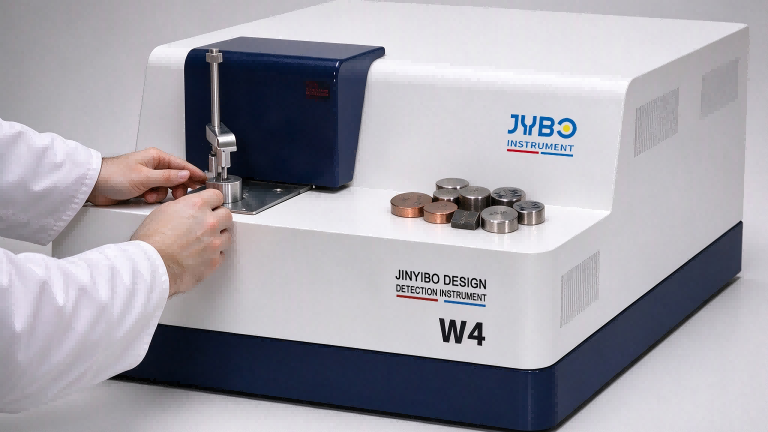
3. Open sample stand accommodates scrap specimens of varying physical dimensions. When paired with a sample grinder or mini-lathe, polished samples produce complete elemental readings; software automatically matches results against alloy grade libraries.
4. Optimised argon-gas workflow: 5 L/min argon consumption in spark mode with intelligent pulsed argon purging lowers long-term consumable expenses under high-volume repeated-testing conditions.
Typical Application Scenarios for W4 OES
1. Scrap-metal recyclers & metal traders: Inbound receiving inspection, mixed-alloy discrimination, scrap grading & pricing, arbitration confirmation for ambiguous samples pre-screened by XRF.
2. Foundries & smelters (furnace-side QC): Verify incoming scrap feedstock quality to prevent defective batches and secure casting output quality.
3. Metal-processing manufacturers: Incoming raw-material validation and identification of in-house returned scrap cuttings.
4. Small-medium material laboratories & mini-third-party test labs: Budget-friendly bench-top OES for multi-matrix metal quantitative analysis.
Limitations: Samples must have flat polished metallic surfaces; heavily rusted, painted or coated samples cannot be directly measured (grinding / lathing is mandatory). This is a bench-top laboratory instrument and is not designed for portable field operation without mains-power and argon gas.
Key Takeaways
The W4 is an economical bench-top Arc-Spark OES optimised for scrap-metal sorting, alloy grade identification and furnace-side rapid analysis.
CMOS full-spectrum UV-Vis detection overcomes handheld XRF limitations for light-element analysis (C / B / N) to deliver definitive quantitative scrap-grade results.
Supports ferrous, aluminium, copper, nickel, titanium and other mainstream scrap-metal matrices for recyclers, foundries and incoming-QC departments.
Compact physical footprint, manageable operating-costs, complete supply kit, on-site installation training and global-oriented after-sales framework.
Bench-top laboratory instrument requiring polished sample preparation, high-purity argon and suitable lab conditions; not for portable field-yard deployment.
FAQ
Q1: Can W4 OES fully replace handheld XRF for high-volume yard screening?
A: Not exactly. Handheld XRF is ideal for high-volume preliminary yard screening. W4 OES is used for final quantitative arbitration testing for ambiguous samples, enabling light-element measurement that XRF cannot achieve. Best-practice workflow: XRF for bulk screening, send questionable specimens to W4-OES for definitive confirmation.
Q2: Are W4 test results reliable for chemically-inhomogeneous scrap-metal samples?
A: The HEPS high-energy pre-combustion function improves excitation performance for non-homogeneous scrap. Samples must be ground flat and clean. For heavily segregated scrap material, average readings from multiple spark points are advised. Special alloy matrices require calibration against matching certified reference samples.
Q3: Does W4 support remote access to test data?
A: Yes. Ethernet TCP/IP communication enables remote instrument status monitoring together with cloud-print functions for centralised test-report archiving.
Q4: Which consumables require regular replacement?
A: Tungsten electrodes, electrode brushes, sealing O-rings, exhaust filter cartridges, degreasing cotton and others. The manufacturer provides long-term supply for the full range of consumables at favourable terms.
Please contact us for further inquiries or detailed information!
Tel:+86-183-5283 6805
Email:sales@jinyibo.com
Web:www.jinyibo.com