
Commonly Used Consumables for Spark Optical Emission Spectrometers
Jul 16 , 2026
During high-frequency routine operations, the fastest-consuming and most critical consumables for a Optical Emission Spectrometer (OES) are High-Purity Argon Gas 99.999%(5N Grade), Tungsten Electrodes, and Sample Preparation Abrasive Disc/Sandpaper. Neglecting the regular maintenance and replacement of these core components is the leading cause of data drift, poor excitation (white spots), and optical system contamination.
Based on long-term metallurgical laboratory operations and instrument maintenance data, here is the complete breakdown of Spark OES consumables and wear parts:
Gas purity and pneumatic stability directly impact the excitation efficiency and spectral line intensity.
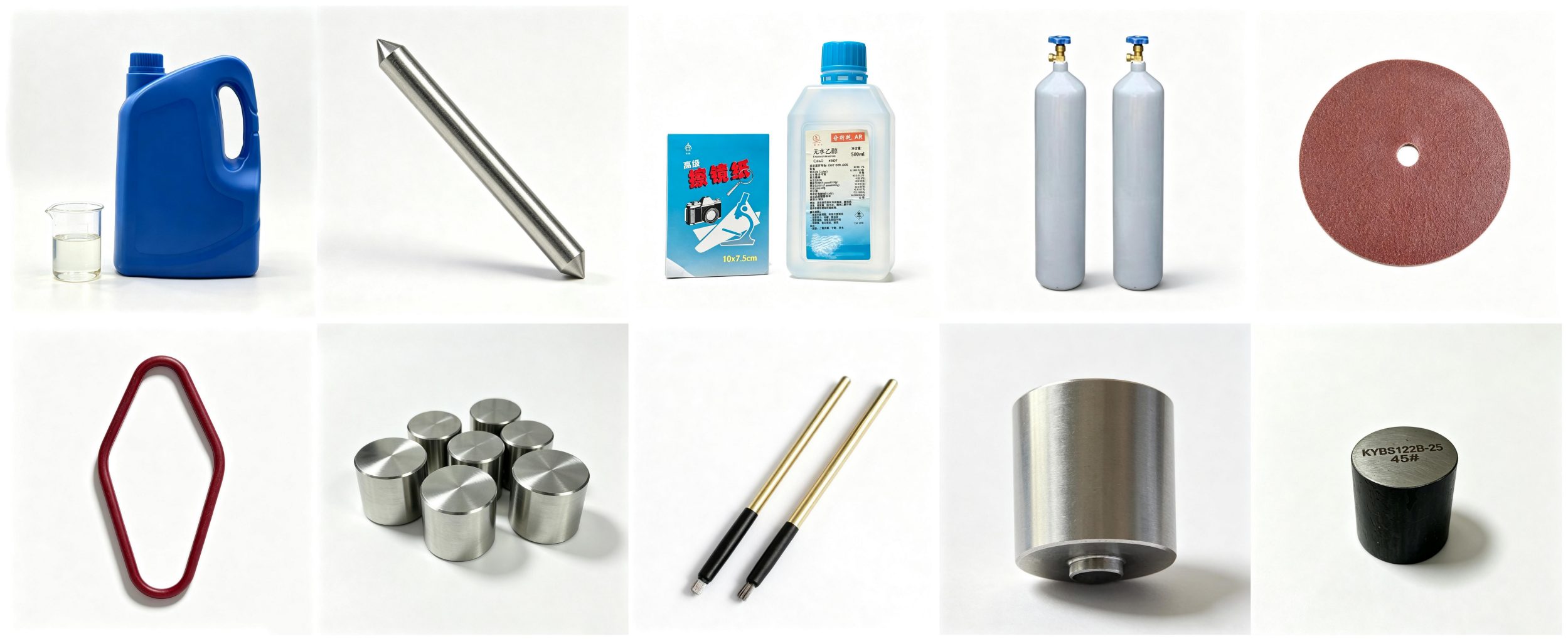
High-Purity Argon Gas (Argon Gas): The single most critical consumable. Spark Spectrometer must perform excitation under a protective argon atmosphere to prevent interference from atmospheric oxygen and nitrogen. The required purity is typically ≥ 99.999% (5N Grade).
Argon Purifier / Filter Elements: Used to inline-purify the gas line by capturing trace moisture, oxygen, and other hydrocarbons.
Pneumatic O-Rings (Sealing Rings): Rubber seals located inside the spark stand and pneumatic joints. They degrade and age over time and must be replaced regularly to prevent ambient air leaks.
The excitation system is the operational "frontline" of the instrument and experiences the most direct wear.
Tungsten Electrodes : The core discharge electrode. Despite regular cleaning after each analysis, high-energy spark discharges cause electrode erosion, tip deformation, and shortening over time. This is a high-frequency replacement item.
Electrode Brushes & Electrode Gauge (Gap Gauge): Essential maintenance tools used for cleaning metal carbon deposits off the electrode and calibrating the precise analytical gap between the electrode and the sample surface.
Insulating Sleeves / Ceramic Insulating Discs: Located at the center of the spark stand, these ceramics withstand thousands of degrees of spark temperatures and are highly prone to carbon tracking, cracking, or pitting.
Vacuum Tools: Used to clear out accumulated metal dust and condensates from inside the spark stand matrix.
Keeping the light path pristine is paramount to guaranteeing optimal detection limits and spectral resolution.
Lens Cleaning Wipes & Anhydrous Ethanol / Isopropyl Alcohol (IPA): Industrial-grade optical wipes and high-purity solvents used to clean the quartz entrance window and accessible optical lenses.
Vacum Pump Oil (Exclusive to Vacuum-Gated Systems): For spectrometers using a vacuum optical chamber (non-argon purged), the rotary vane vacuum pump oil must be changed periodically to sustain low-pressure vacuum metrics and prevent oil backstreaming.
Accurate chemical analysis relies heavily on proper surface preparation and regular instrument drift correction.
Sample Prep Consumables (Sandpaper / Grinding Belts / Milling Cutters):
For Ferrous Metals (Steel/Iron): Specialized zirconia/corundum grinding belts or sandpaper discs of various grits are required to achieve a flat, clean surface.
For Non-Ferrous Metals (Aluminium/Copper): High-speed milling cutters must be used to prevent surface smearing and contamination.
Certified Reference Materials (CRMs) & Calibration Samples:
Recalibration Samples (Setting-up Samples / RE-Samples): Used for daily drift correction (standardization) to compensate for baseline instrument drift.
Type Standardization Samples (SUS / Control Samples): Used for matrix-specific fine-tuning of exact metal grades.
Among all OES parts, argon gas, sample grinding sandpaper, and tungsten electrodes exhibit the highest consumption rates.
Please contact us for further inquiries or detailed information!
Tel:+86-183-5283 6805
Email:sales@jinyibo.com
Web:www.jinyibo.com

© Copyright © 2026 Wuxi Jinyibo Instrument Technology Co.,Ltd All Rights Reserved.
Sitemap | Xml | Privacy Policy | 苏ICP备18046951号-1