What Can Full-Spectrum Arc/Spark OES Detect in Metallic Samples?
Overview
A full-spectrum Arc/Spark Optical Emission Spectrometer (OES) enables rapid, simultaneous qualitative and quantitative elemental analysis of solid, electrically conductive metal samples. It can determine major alloying elements, trace impurities, and important light and trace elements such as Carbon (C), Sulfur (S), Phosphorus (P), Boron (B), Arsenic (As), and Nitrogen (N), depending on the metal matrix and calibration configuration.
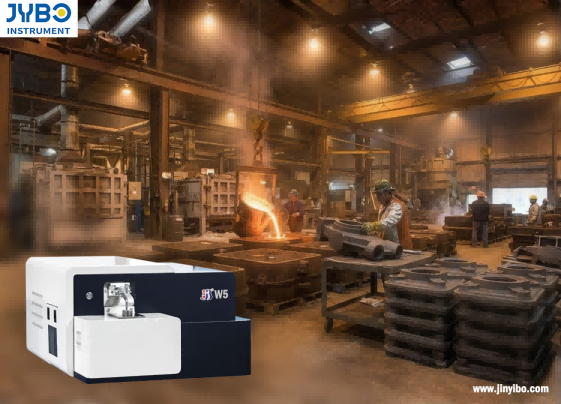
The JINYIBO W5 Optical Emission Spectrometer (OES) is a fourth-generation, high-performance CMOS-based Arc/Spark OES system designed for metal composition analysis. With a full-vacuum optical system, digital HEPS excitation source, and multi-channel CMOS detector, W5 provides reliable elemental analysis for incoming material inspection, foundry melt monitoring, and finished-product quality control across ferrous and non-ferrous metal industries.
What Exactly Does Full-Spectrum OES Measure in Metal Samples?
Full-spectrum Arc/Spark OES analyzes the elemental composition of metallic samples by measuring the characteristic optical emission wavelengths generated when a sample is excited by an electrical discharge.
Unlike handheld X-ray fluorescence (XRF) analyzers, which have limitations when measuring certain light elements, conventional Arc/Spark OES is particularly suitable for analyzing elements such as Carbon, Sulfur, Phosphorus, and other elements that are important for metal grade identification and metallurgical quality control.
1. Detectable Element Categories
Major Alloying Elements
OES can measure the principal alloying elements that determine the composition and grade of metals, including Fe, Cu, Al, Ni, Co, Mg, Ti, Zn, Pb, Sn, Ag, Mn, and Cr.
Trace Impurity Elements
OES can also determine low-concentration impurity elements in metallic materials. Actual detection limits depend on the element, metal matrix, instrument configuration, and calibration range.
Important Light and Trace Elements
Key elements include C, S, P, B, As, and N. These elements play important roles in determining the mechanical properties, chemical characteristics, and metallurgical performance of steel, cast iron, and other metal alloys.
Their accurate measurement is particularly important in applications where conventional handheld analytical instruments may have limited capabilities.
2. Supported Metal Matrices
Optical Emission Spectrometer (Arc/Spark) can be configured for a wide range of ferrous and non-ferrous metal matrices.
Ferrous Metals:Carbon steel,Low-alloy steel,Stainless steel,Cast iron
Non-Ferrous Metals:Aluminum-based alloys,Copper-based alloys,Nickel-based alloys,Cobalt-based alloys,Magnesium-based alloys,Titanium-based alloys,Zinc-based alloys,Lead-based alloys,Tin-based alloys,Silver-based alloys,Manganese-based alloys......
The available analytical elements and measurement ranges depend on the corresponding calibration programs and instrument configuration.
3. Practical Industrial Testing Applications
Full-spectrum OES is widely used in metal production, processing, and quality inspection. Its main applications include:
PMI and Alloy Grade Identification: Determines the elemental composition of metal materials and compares the results with applicable alloy specifications to verify material grades.
Foundry Melt Composition Monitoring: Provides rapid elemental analysis of molten-metal production samples, helping foundries adjust alloy composition before casting.
Incoming Material Inspection: Verifies the chemical composition of purchased raw materials, metal billets, and alloy components.
Finished-Product Quality Control: Checks whether manufactured metal products meet the required chemical composition specifications.
Material Homogeneity Evaluation: Supports composition consistency checks on cast ingots, forgings, and other metal products through representative sampling.
Production Traceability: Generates elemental analysis reports to support batch management, quality documentation, and production process optimization.
4. Known Limitations of Arc/Spark OES
Conventional Arc/Spark OES is designed for the direct analysis of solid, electrically conductive metal samples. It is generally not suitable for direct analysis of loose metal powders, liquid melts, non-conductive materials, thin surface coatings, or dissolved solutions.
Sample preparation is also important for reliable measurement. Metal samples typically require grinding or machining to obtain a clean, flat, and fresh surface before spark excitation. Appropriate sample preparation helps minimize surface contamination, oxidation, and other factors that may affect analytical results.
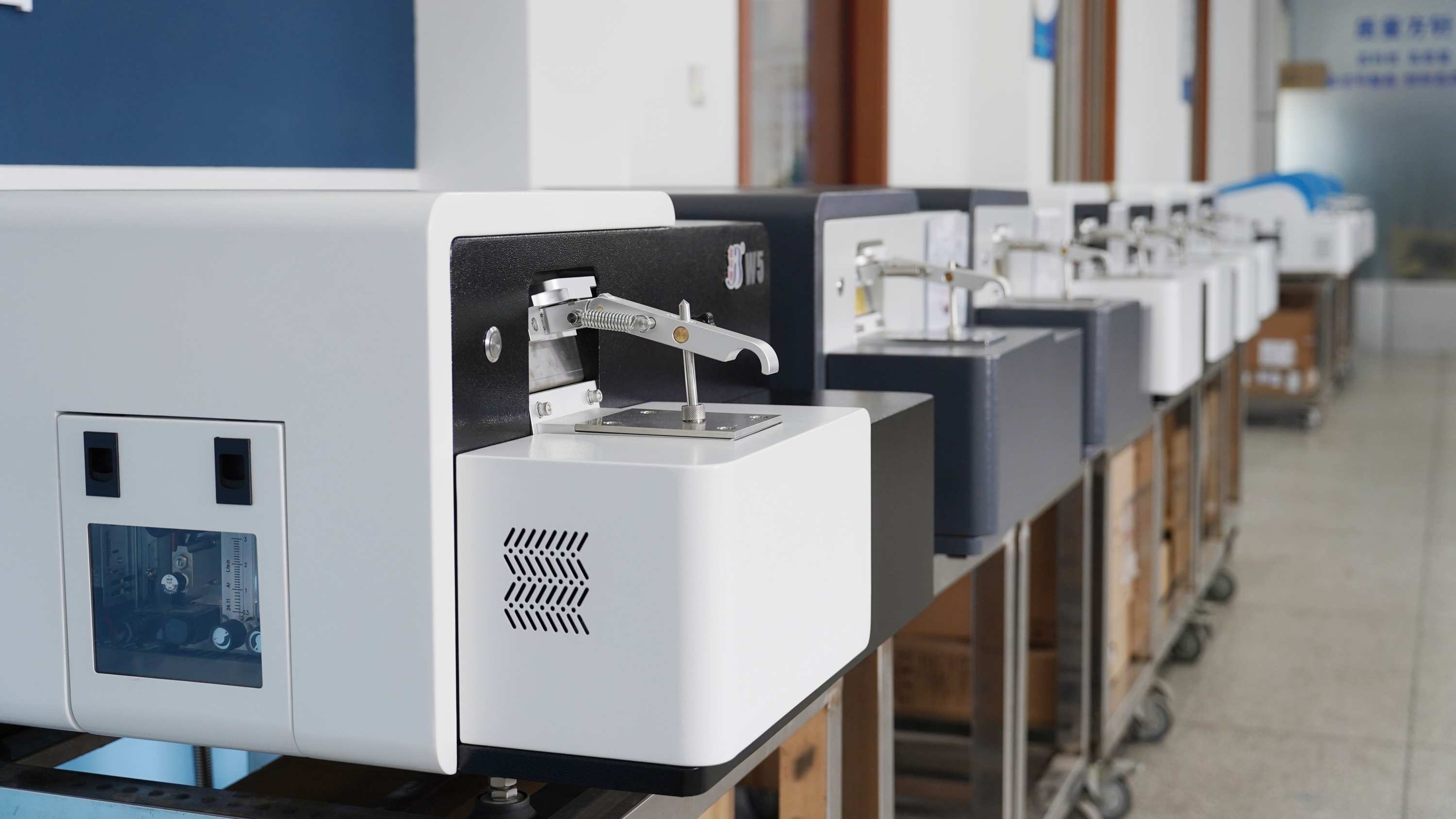
JINYIBO W5 OES – Fourth-Generation Full-Spectrum CMOS Arc/Spark Spectrometer
The JINYIBO W5 Optical Emission Spectrometer is a fourth-generation Arc/Spark OES system designed for high-performance metal elemental analysis. Its multi-channel CMOS detector provides full-spectrum measurement capabilities, combining broad wavelength coverage with high sensitivity for the analysis of important elements in metallic materials.
Equipped with a vacuum constant-temperature optical chamber and an intelligent digital HEPS excitation source, W5 is designed to deliver stable analytical performance and reliable measurement results. Its configurable analytical programs support different ferrous and non-ferrous metal matrices, making it suitable for routine laboratory testing and industrial quality control.
W5 OES Technical Specifications
| Item |
Key Specifications |
| Optical System |
Paschen–Runge full-vacuum optical system; wavelength range: 165–589 nm (expandable); focal length: 400 mm; diffraction grating: 2,400 lines/mm |
| Detector |
Multi-channel, high-performance linear CMOS array; average resolution: 10 pm/pixel |
| Excitation Source |
HEPS digital excitation; frequency: 100–1,000 Hz; discharge current: 1–400 A; high-energy pre-burn technology |
| Argon Gas Requirements |
99.999% high-purity argon; argon flow rate during excitation: 3–5 L/min; no argon consumption in standby mode |
| Analysis Speed |
Analysis of configured elements can be completed within approximately 20 seconds, depending on sample and analytical program |
| Dimensions and Power Consumption |
Dimensions: 860 mm (L) × 680 mm (W) × 438 mm (H); approximate weight: 100 kg; maximum power consumption: 750 W; standby power consumption: 100 W |
Core Functional Advantages of W5 OES
1. Vacuum Constant-Temperature Optical Chamber
The vacuum optical system minimizes optical absorption and interference caused by air in the optical path, supporting improved sensitivity and measurement stability. Temperature control helps maintain consistent optical conditions during long-term operation. MgF₂ optical components are used to support ultraviolet-range performance.
2. Intelligent Digital HEPS Excitation Source
The digital HEPS excitation source provides programmable discharge parameters and stable excitation conditions. Its adjustable settings allow optimization for different metal matrices, analytical elements, and sample geometries. High-energy pre-burn technology helps establish stable excitation conditions before measurement.
3. Intelligent Integrated Argon Gas System
The integrated argon gas system provides controlled argon purging during spark excitation. Argon flow helps maintain a suitable excitation atmosphere, while the optimized gas delivery design helps reduce plasma instability and improve measurement consistency. No continuous argon supply is required during standby, helping reduce operating costs.
4. Intelligent Vacuum Management
The program-controlled vacuum management system helps regulate vacuum pump operation and maintain the required optical chamber conditions. Multi-stage vacuum isolation and an absorption trap help reduce the risk of contamination from pump oil vapor and other impurities.
5. Convenient Optical Maintenance Design
The detachable single-lens design facilitates optical maintenance and cleaning. It also helps reduce the risk of contamination entering the internal optical system during routine servicing.
6. Professional Multi-Language Analysis Software
The analysis software supports multiple metal matrix calibration programs and configurable analytical elements. Functions include spectral interference correction, standardized parameter modification, control sample correction, remote data transmission, customizable test reports, and synchronized display on compatible devices.
7. Broad Metal Matrix Compatibility
W5 supports a wide range of ferrous and non-ferrous metal matrices, including iron, copper, aluminum, nickel, cobalt, magnesium, titanium, zinc, lead, tin, silver, manganese, and chromium-based alloys. Analytical elements and calibration programs can be configured according to specific testing requirements.
FAQ
Q1: Can W5 OES measure Carbon, Sulfur, and Nitrogen in steel?
A: Yes. W5 OES supports the analysis of important light and trace elements, including Carbon (C), Sulfur (S), Phosphorus (P), Boron (B), Arsenic (As), and Nitrogen (N), subject to the applicable steel matrix calibration and analytical range.
Q2: What sample preparation is required for W5 OES testing?
A: Solid, electrically conductive metal samples generally need to be ground or machined to obtain a clean, flat, and fresh surface before spark excitation. Suitable sample preparation helps ensure reliable and repeatable analytical results.
Q3: Does W5 OES require continuous argon flow during standby?
A: No. Argon is supplied during spark excitation at a typical flow rate of 3–5 L/min. No continuous argon flow is required during standby, helping reduce argon consumption and operating costs.
Q4: What types of metals can W5 OES analyze?
A: W5 OES supports a variety of ferrous and non-ferrous metal matrices, including iron-based, copper-based, aluminum-based, nickel-based, cobalt-based, magnesium-based, titanium-based, zinc-based, lead-based, tin-based, silver-based, manganese-based, and chromium-based alloys. The available analytical elements depend on the corresponding calibration programs and instrument configuration.
Please contact us for further inquiries or detailed information!
Tel:+86-183-5283 6805
Email:sales@jinyibo.com
Web:www.jinyibo.com